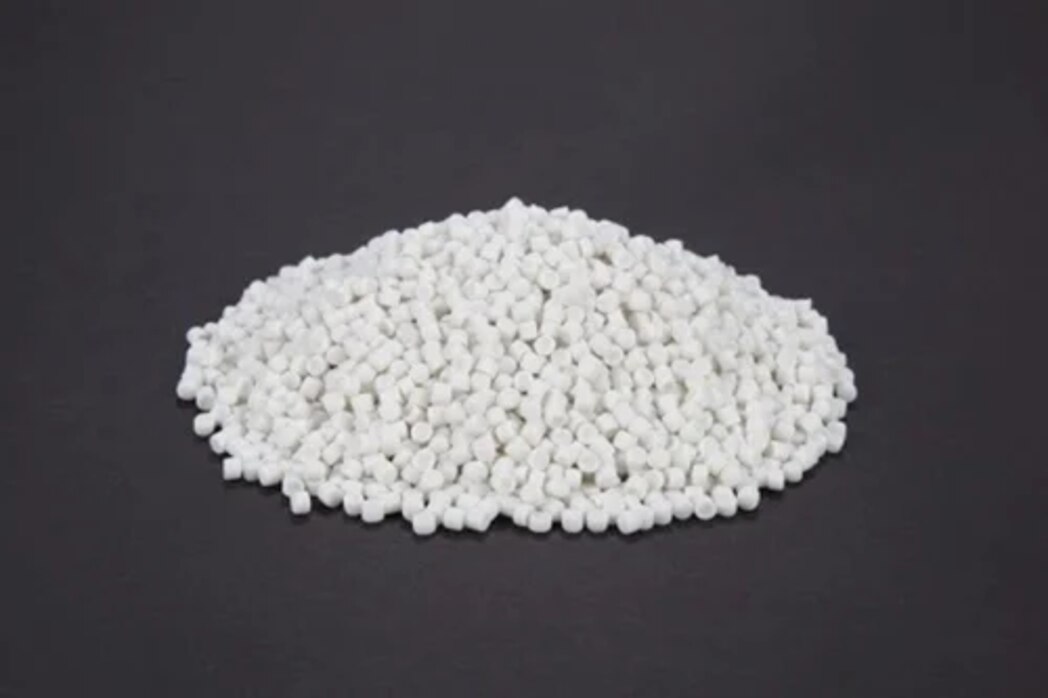
A PVC compound that looks suitable on a datasheet can still fail at the die, in the mold, or during service because its formulation and fusion behavior do not match your process. Use the process, end-use duty, measurable acceptance limits, and controlled trial data to narrow the choice and qualify a supplier with evidence rather than labels.
Key takeaways
- Match the compound to melting method, die geometry, and finished-part service conditions.
- Separate rigid and flexible PVC by plasticizer content, hardness, and required performance.
- Set measurable limits for fusion, colour, moisture, density, and mechanical properties before ordering.
- Use controlled trial runs to distinguish compound faults from equipment or process faults.
Start With the Process and the Finished Part
Match the PVC compound to how it will be melted and shaped, then to the conditions the finished part must survive. PVC extrusion and profile production require stable fusion through continuous shear, controlled die swell, and the actual barrel temperature and residence-time window.
Injection molding needs enough flow to fill the cavity without premature degradation, while calendaring needs uniform fusion and release across heated rolls.
Cable insulation and sheathing add electrical, flame, oil, abrasion, and temperature requirements that a general-purpose compound cannot prove by hardness alone. Flexible grades for cables or seals also need checks for plasticizer migration and extraction.
Use this procedure for PVC compound selection:
1. Record the machine, screw or roll conditions, output rate, part thickness, cooling method, and residence time.
2. Specify the fusion target under those conditions. Compare fusion time, fusion torque, and degradation with ASTM D2538 torque-rheometer testing; do not replace a fusion curve with melt-flow data alone.
3. Match resin K-value and formulation to the process. Higher K-value tends to improve strength but increases viscosity and fusion demand; porosity, particle morphology, lubricants, fillers, and stabilizers also change processing.
4. Trial the compound in the actual tool, then test the finished part. Use the required cable, flame-spread, smoke, ignition, or other end-product test; a thickness-specific UL 94 result is not a universal rating for every assembly.
Separate Rigid PVC From Flexible PVC Formulations
Rigid PVC uses little or no plasticizer, so resin molecular weight, filler loading, and impact modifier selection control stiffness, strength, and toughness. A higher PVC resin K-value can improve strength but raises melt viscosity and fusion demand; compare fusion time, torque, and degradation with ASTM D2538 torque-rheometer data, not melt-flow numbers alone.
Flexible PVC gains elongation and lower Shore hardness from higher plasticizer content, but the same change can reduce modulus and heat resistance. Plasticizer compatibility at room temperature does not prove service permanence: require ASTM D1239 extraction data and ASTM D1203 volatile-loss data against the actual media and temperature.
Compare these formulation levers before choosing a compound:
- Resin: Check K-value, porosity, particle morphology, and plasticizer uptake; equal K-values do not guarantee equal processing.
- Plasticizer: Match type and phr to hardness, elongation, migration, fogging, oil contact, or medical use.
- Filler: Higher loading can reduce cost and shrinkage but also lower elongation and alter density, fusion, and electrical properties.
- Modifier: Impact modifiers improve toughness in rigid PVC but can change heat resistance, gloss, and processability.
For cable insulation, compare ASTM D149 dielectric strength and ASTM D257 volume resistivity only with matching specimen thickness, conditioning, temperature, humidity, and plasticizer content. Define regrind percentage by formulation and verify each lot’s color, density, fusion behavior, and mechanical properties.
Compare the Formulation, Not Just the Compound Name
Two PVC compounds with the same application label can behave differently because formulation controls fusion, viscosity, permanence, stiffness, and surface finish. Compare the supplier’s formulation sheet, not just the trade name.
| Variable | Compare | Why it changes the decision |
|---|---|---|
| PVC resin K-value | K-value, resin porosity, and particle morphology | Higher K-value can improve strength but raises melt viscosity and fusion demand. Similar K-values can still process differently. |
| Plasticizer type and loading | Plasticizer identity, phr, extraction, and volatile-loss data | Compatibility at room temperature does not prove permanence. Check ASTM D1239 and ASTM D1203 results against the service media and temperature. |
| Stabilizer system | Calcium-zinc, organotin, or other chemistry; dosage | Thermal stability, color retention, regulatory status, and resistance to HCl-related degradation differ. |
| Impact modifier | Type and loading | It can improve toughness while changing stiffness, fusion, gloss, and cost. |
| Lubricant package | Internal and external lubricant balance | An unsuitable balance causes poor fusion, plate-out, die pressure, or rough surfaces. |
| Filler loading | Calcium carbonate percentage and particle treatment | Filler changes density, elongation, impact strength, finish, and cost per processed volume. |
| Pigment or flame retardant | Chemistry, loading, and dispersion | These affect color consistency, smoke, electrical properties, and processing stability. |
Ask for density and ash data, then compare compounds at the same finished-part volume rather than by price per kilogram. Qualify both candidates on the intended machine: resin structure, additive package, shear, residence time, and stoppages can determine whether discoloration or black specks appear.
Set Measurable Acceptance Limits Before Ordering
A purchase specification needs pass/fail numbers, not phrases such as “high strength” or “good heat stability.” Set each limit from the finished part and validate it on the intended machine, because residence time, shear and dead spots can create discoloration even at the correct barrel temperature.
| Property | Acceptance limit to define | Test and record |
|---|---|---|
| Hardness | Shore A or Shore D target, with a ±3-point tolerance | ASTM D2240; conditioning time and temperature |
| Mechanical | Minimum tensile strength and elongation, such as ≥12 MPa and ≥250%, only where validated | ASTM D638; specimen type and conditioning |
| Density | Target in g/cm³, with a defined lot tolerance such as ±0.03 g/cm³ | ASTM D792; report filler or regrind status |
| Heat | Minimum Vicat softening point, for example ≥75°C, at a named load and heating rate | ASTM D1525; do not treat it as continuous-use temperature |
Add thermal-stability time at the processing temperature, color or ΔE limit, ash, moisture, fusion behavior and, for electrical PVC, dielectric strength under ASTM D149 and volume resistivity under ASTM D257. State specimen thickness, humidity and conditioning; otherwise the figures cannot be compared.
Require a certificate of analysis for every lot, batch traceability, SDS, formulation or regrind declaration, manufacturing date, and regulatory documents identifying REACH restrictions, RoHS status where relevant, and the analytical basis.
Use Trial Runs to Separate Compound Problems From Equipment Problems
Run the candidate compound on the intended machine at the target throughput, using a clean barrel, documented screw, stable cooling, and a fixed residence time. Record barrel-zone settings, screw speed, die temperature, pressure, melt temperature, and output before changing one variable at a time.
Check fusion behavior rather than relying on melt flow alone. ASTM D2538 torque-rheometer results let you compare fusion time, fusion torque, and degradation against an approved compound; confirm the result at production shear and residence time. A compound that fuses late can leave rough, weak parts, while early fusion can increase torque and heat.
Use defect patterns to separate material from equipment causes:
- Black specks: inspect dead spots, long stoppages, purging practice, and HCl-related degradation before rejecting the compound.
- Bubbles: check moisture, trapped air, venting, and melt temperature; persistent bubbles after those checks indicate volatile contamination.
- Plate-out or die drool: compare lubricant and stabilizer behavior, then inspect die temperature and deposits.
- Roughness: check fusion, screen-pack condition, die damage, and excessive filler.
- Color variation: hold melt temperature and residence time steady, then compare pigment dispersion and thermal stability.
- Shrinkage: measure density and cooling history; inconsistent wall thickness points to tooling or process control.
- Brittle parts: test formulation, fusion, filler loading, and aging separately from cooling and orientation effects.
Qualify Cable Compounds and Suppliers Against the Actual Duty
Select cable insulation for dielectric strength, volume resistivity, flexibility, conductor temperature and electrical aging. Select cable sheathing for abrasion, oil or chemical contact, sunlight, impact and installation temperature. Check the cable design against IEC 60502-1 where applicable, and verify flame propagation using IEC 60332-1-2 rather than assuming a generic flame-retardant claim is sufficient.
Plasticizer choice affects more than Shore hardness. Higher loading can reduce modulus and heat resistance while increasing migration, fogging and extraction. Require ASTM D1203 volatile-loss data and ASTM D1239 extraction data against the actual fluid and temperature; hardness alone is not evidence of service life.
| Format | Advantages | Controls to compare |
|---|---|---|
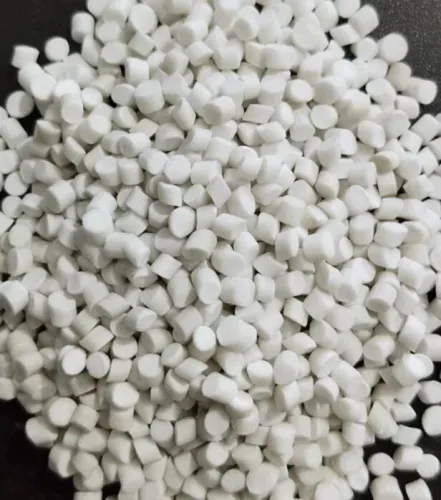
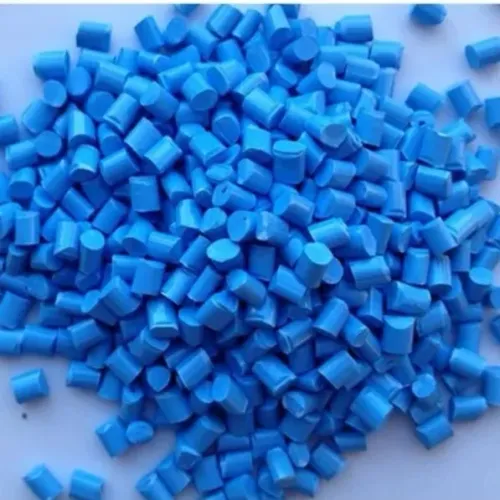
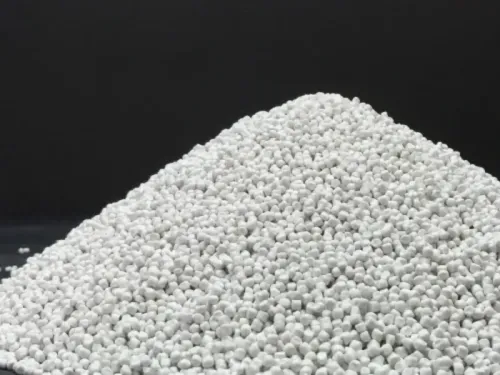
| Pellets | Consistent feeding, cleaner handling, simpler automated dosing | Confirm pellet size, moisture, density and lot variation |
| Dry-blend powder | Useful for integrated high-throughput PVC processing and formulation flexibility | Control dust, moisture, segregation, feeding accuracy and fusion |
Compare cost per processed volume, not price per kilogram, because filler changes density and output. Ask Aim Plastic or any shortlisted supplier for three lot certificates, retained samples, processing guidance and documented limits for density, hardness, tensile strength, elongation, electrical properties and color.
A supplier earns qualification by reproducing those results after a repeat order, not by sending one successful sample.
Related products
 | Aim Plastic is a trusted name for high-quality PVC Plastic Granules, offering dependable material solutions for manufacturers across diverse plastic... View product → |
 | PVC Cable Compound Aim Plastic has established itself as one of Delhi's leading PVC cable compound manufacturers, producing specialized formulations that meet the... View product → |
Frequently asked questions
How should manufacturers begin selecting a PVC compound?
Start with the forming process and finished part. Define the extrusion or molding method, barrel temperature, residence time, die geometry, and service conditions the part must withstand.
What is the difference between rigid and flexible PVC compounds?
Rigid PVC formulations use little or no plasticizer and target stiffness, dimensional stability, and impact performance. Flexible PVC formulations use plasticizers to achieve a specified hardness, bendability, and elongation.
What should manufacturers compare besides a compound’s name?
Compare the formulation and technical data, including resin grade, plasticizer type and level, stabilizer system, fillers, pigments, lubrication, density, hardness, fusion behaviour, and mechanical results.
How can a trial run identify the source of a production problem?
Keep the machine settings, tooling, feed rate, and cooling conditions controlled, then record melt temperature, torque, pressure, output, surface quality, dimensions, and test results. Compare these with a known-good compound to separate material variation from equipment faults.
Related products
 | PVC Rubberised Compound Suppliers PVC Rubberised Compound Suppliers ₹95 Aim Plastic has established itself as a leading PVC rubberised compound supplier in Delhi, providing manufacturers with high-performance flexible... View product → |
 | PVC Transparent Granules Manufacturers PVC Transparent Granules Manufacturers Aim Plastic stands as a premier PVC transparent granules manufacturer in Delhi, producing high-clarity compounds that meet the most demanding visual... View product → |
 | FRLS PVC Compound Suppliers ₹98 Aim Plastic has established itself as a premier FRLS PVC compound supplier in Delhi, providing manufacturers with high-performance flame retardant,... View product → |
 | ZHFR Compound Suppliers ₹124 Aim Plastic has positioned itself as a leading ZHFR (Zero Halogen Flame Retardant) compound supplier in Delhi, providing manufacturers with advanced... View product → |